The short answer
A real sock factory can tell you, in one email, how many machines it runs, which brands and gauges they knit — and it can send a workshop video the same day. A middleman usually cannot. Below are seven checks you can run in about a week. At the end, we tell you plainly which one we are. (Spoiler: we are not a factory — and we will explain why that can still work in your favour, as long as you know exactly what you are paying for.)
Why “is this a real factory?” is the first question every buyer asks
It is not because factories are honest and traders are not. It is because the answer tells you whose risk you are carrying.
China’s sock production is concentrated in a handful of industrial clusters — Zhuji and Datang in Zhejiang, and Liaoyuan in Jilin, known in the trade as “south Zhuji, north Liaoyuan.” The Liaoyuan cluster alone reports annual output of around 3.5 billion pairs across more than 1,200 companies, and in 2025 it was recognised as a regional consumer-goods brand in China’s first national list published by the Ministry of Industry and Information Technology (Liaoyuan municipal government figures, 2025).
In a cluster that dense, the distance between a genuine mill and an export agent is short — and invisible from a website. Some companies that present themselves as factories are trading offices with a good photo library. Some genuine mills have no English presence at all. When something goes wrong mid-production, the question that matters is brutally simple: are you talking to the people who own the machines, or to someone who is now relaying your complaint to a third party?
So before comparing prices, run the seven checks below. They take about a week, they cost nothing, and they settle the identity question with far more reliability than any “About Us” page.
Checks 1–3: what a real factory can answer in five minutes
Check 1 — Machine count, machine brands, and gauge
Ask one question: “How many machines do you run, what are they, and what gauge?”
A real factory answers with numbers immediately: how many knitting machines, which families (Lonati and Santoni from Italy, Korean brands, domestic Chinese machines), which gauges they cover — for socks, typically somewhere between 84N and 200N — and how many shifts they run.
A middleman answers with adjectives: “very advanced equipment,” “modern workshop,” “it depends on your quantity.” If the answer to a machine question is a pricing question, you are not talking to the mill.
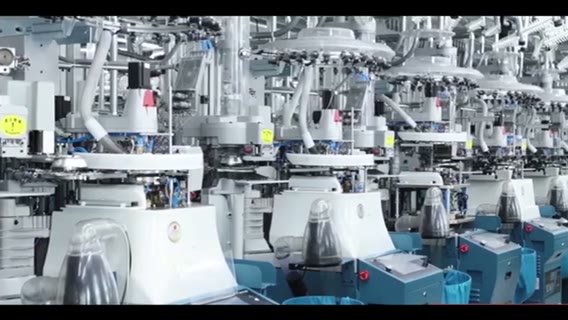
For reference, this is what a concrete answer looks like. One of our production partners, Jilin Luren (吉林省鹿人袜业有限公司) in Liaoyuan, was founded in 2007 and operates more than 950 machines and finishing units with annual capacity of over 70 million pairs. That is the level of specificity you should expect — and be able to verify — from anyone producing your socks.
Check 2 — Does the address match the business scope?
Ask for the business licence and read two things: the registered address and the business scope (经营范围).
- A mill’s production address is in an industrial park, and its scope includes manufacturing (制造 / 生产).
- A trading office registers in a city-centre office tower, and its scope reads wholesale, trading, import & export, or supply-chain management.
Neither one is automatically a red flag — but the two must be consistent with the story you are being told. A “factory” with an office-tower address and a pure trading scope is telling you one thing on its website and another on its licence. That mismatch is the red flag.
Check 3 — Ask for a workshop video, today
Ask the supplier to send a short video of the knitting floor — today, or on a live video call where they walk the floor and take your questions in real time.
A real factory can do this within hours, because the machines are down the corridor. Ask them to show machines running, the order board, and today’s date on a whiteboard. A middleman will offer catalog footage, a “factory tour” filmed years ago, or reasons why today is inconvenient.
We hold recent walkthrough footage of our partner mills’ knitting, finishing and packing floors, and we are happy to share it with a first reply — or walk the floor with you on a live video call.
Checks 4–5: the paperwork tests
Check 4 — Read the business scope, not the website
This overlaps with Check 2 but deserves its own step, because most buyers do it in the wrong order: they read the website first and let it frame everything after. Reverse that. Read the licence first, then judge the website against it.
Three details tell you most of what you need:
- The scope line: manufacturing, or trade?
- The company name itself: words like Trading, Import & Export, or Supply Chain in a company’s registered name are, in China, a reliable indicator of what the company actually is.
- The date of establishment, cross-checked against the story you’ve been told (“18 years of production” from a company registered in 2023 is a story, not a history).
One caution: a company name that says “supply chain” is not proof of dishonesty. It tells you what you are buying — a service, not capacity. Judge it on that basis, and it can be exactly the right choice. More on this below.
Check 5 — Certificates: ask for the number, not the logo
Logos are easy to paste; numbers are not. For any certificate a supplier claims, ask for the certificate number and issuing body, then verify it yourself:
- OEKO-TEX® Standard 100: the certificate ID can be checked in the public database at oeko-tex.com — it returns the holder, the product class, and the validity dates.
- ISO 9001:2015: ask for the certificate number and the certification body, and check that the body is accredited.
- BSCI / SMETA audits: ask for the audit report ID (or a summary page) and the audit date. A genuine audit has a trail; a claimed one does not.
A supplier who hesitates to give you a verifiable number is telling you something — even if the certificate exists, hesitation usually means the certificate belongs to a different company than the one you are paying.
Checks 6–7: the behavioural tests
Check 6 — Will they accept a third-party audit?
Offer to commission an inspection or audit through a third party — SGS, Bureau Veritas, TÜV, or a local inspection agency. A genuine factory is audited constantly and will not blink; the conversation moves straight to scheduling and cost. A supplier whose “factory” cannot survive a visit will start negotiating you out of it: “minimum order too small for an audit,” “we are very busy this month,” “our factory is in another city.”
You do not need to actually commission the audit to learn what you need — although before a large order, you should. The reaction to the offer is itself the test.
Check 7 — How do they answer “who is your factory?”
This is the sharpest question in the set, and the one we recommend asking last, after rapport is established. Ask it plainly: “Who is your factory? What’s the company name?”
- A fake factory gets vague: “our group has several plants,” “we’ll introduce you later,” “why do you ask?”
- An honest exporter answers instantly — with a name, a city, and numbers — and explains what they themselves are responsible for: specifications, quality control, export documentation.
The difference is not about shame. Companies that hide their mill have something to hide; companies that name their mill are selling transparency. So, in the spirit of Check 7 — here is ours.
Where SOXMILL sits — and how to check us
SOXMILL is not a factory, and we do not claim to be one. We are the international sales and export arm for socks, underwear and apparel, operated by Beijing Haifu Supply Chain Co., Ltd (北京海服供应链有限公司). What we sell is direct access to audited partner mills, without the mill-level workload: production is delivered by a network of long-standing, audited partner mills that we specify for, audit and quality-check, with SOXMILL as your single supplier of record.
Our production partners include Jilin Luren (吉林省鹿人袜业有限公司) in Liaoyuan, Jilin — a specialist sock mill founded in 2007, operating 950+ machines with annual capacity above 70 million pairs, and a provincial-level certified R&D centre. Liaoyuan is one of China’s two great sock clusters, with annual cluster output of roughly 3.5 billion pairs.
Now run the checks on us. Ask us Check 1 — we will answer with numbers. Ask Check 3 — we will send the video. Ask Check 2 and 4 — our licence reads “supply chain,” and we would rather you knew that from us than discovered it from the licence. Ask Check 7 — you already have the answer, because it is printed above.
For most buyers, that is the right trade. You get mill-level pricing and named, verifiable production capacity, without managing machine schedules, dye-lot minimums and export paperwork yourself. If you need a single category at maximum volume and minimum price, go to a mill directly — and use the same seven checks there. If you want one contact across categories with QC and documentation handled, that is what an export house is for. Either way, you now know how to tell which one you are actually talking to.
Last updated: October 2026. Cluster and mill figures sourced from Liaoyuan municipal government publications and Jilin Luren’s official disclosures; verify current figures independently.